At least one in three doctoral students has serious mental health problems. In the previous report, we looked at the causes, including work-life balance difficulties. We have now interviewed representatives of Spanish female researchers in four countries with different workloads: Germany, the USA, Denmark and the Netherlands.

This report is the second in a three-part series. Our purpose here is to analyse occupational health risks among researchers, point out their causes and propose alternatives.
This report is the second in a three-part series. Our purpose here is to analyse occupational health risks among researchers, point out their causes and propose alternatives.
In the previous report we presented the mental health problem existing on a global scale in the world of scientific research. In this second part, we interviewed representatives of Spanish scientific associations in four countries: Germany, the United States, the Netherlands and Denmark.
Why these four? Available surveys (an estimate of researchers' working hours in 12 European countries and a survey conducted by Nature magazine among PhD students worldwide) suggest that Germany and the United States have longer working hours, and the Netherlands and Nordic countries, such as Denmark, have more rational hours.
We have asked all three of them the following questions:
1) What is the length of the working day in the research centres in the country where you work?
2) Do you think that long working hours and an atmosphere of pressure improve scientific productivity? What other factors influence this?
3) What would you change in this competitive model on the basis of publications?

Noelia Lozano Vidal
1) Working hours in the Netherlands are similar to those in Spain, between 38 and 40 hours a week. These hours are generally adhered to and it is normal to take days off if needed. For example, after having children, both parents can work four days a week instead of five, which is widely accepted both socially and at work.
2) Despite the fact that at certain times pressure and long working days increase productivity, if this situation is maintained or becomes chronic, motivation and analytical capacity decrease, tiredness and anxiety increase... And I think there are other factors that are critical too.
For example, here there is a lot of trust in workers and their ability to take their own decisions. The fact that people are not burned out and can separate work from life makes the atmosphere less toxic. It also helps that funding is better, wages are higher and there are more job prospects.
3) The system of evaluating CVs by publications is obsolete, there are many valuable aspects of research that are not seen in scientific articles, including negative results. Good work is not being valued, nor is the performance of tasks that are very necessary for the advancement of research, such as teaching, management and communication. Moreover, the demands are disparate in different areas and the ability to publish an article depends very much on whether or not the topic on which it is based is in vogue; but when it comes to evaluation, everything counts the same.

Alicia Pérez Porro
Pérez Porro answers in her individual capacity and not as a representative of the association.
1) The working hours in American laboratories depend a lot on the field and the laboratory you work in. In general, I don't have the perception that people work more than in Spain, but I do have the perception that nobody comes here simply to heat the chair.
2) It’s not because of long working hours and a pressure environment that more is produced. These environments go against creativity and contribute to the publication of lower quality articles. What increases productivity is having a system behind you that supports you and allows you to dedicate yourself to your work, to research and to write your article, because it already takes care of everything else.
3) What should be changed is the criteria for awarding projects and scholarships. Today everything is based on the number of articles and where you have published them. The publish-or-perish method has turned researchers into data-producing machines, rather than curious people who want to answer questions. Also, if you have to take time off your career because you’ve had a child, because of illness or because you are taking care of a family member, you are left out. That's how a huge amount of talent gets lost.
If the money were distributed according to other criteria, it would increase diversity. We would have more creative scientists with more capacity to bring about new discoveries.

Paula Fernández Guerra
1) Full-time contracts in Denmark are 37 hours per week and great importance is attached to family reconciliation. In science, there are differences. At university, the hours are quite flexible, and the usual overtime is around 45 hours. In hospitals, people usually work from 8 a.m. to 4 p.m. Companies have less flexible schedules, but overtime or weekends are exceptional.
2) In Denmark the departments for the prevention of occupational risks have a person responsible for “happiness at work” or job satisfaction, which has arisen from different studies that show that it is linked to greater productivity and fewer sick leaves. However, we do not know if there are any specific studies on scientific productivity, but there are studies that indicate that researchers undergo more stress and pressure than workers in other sectors.
3) The pressure to publish exists, however, here other aspects are valued, such as the dissemination of science, the organization of congresses or courses, the supervision of students... The objective is to reduce the pressure to publish and to value researchers as a whole.
The publication of negative results or studies that reproduce results should also be favoured, since one of the sources of pressure to publish lies in being the first to do so. If you fail to do so, you are considered to have been unproductive.
On the other hand, greater job stability and funding would increase the quality of research. This pressure and job instability are the main reasons why half of all science-related professionals in Denmark prefer to work in the private R&D system, one of the country's main economic drivers.

Elisa García
1) It is very difficult to make a generalization. The only data that exists are those obtained through surveys of workers, for example, that carried out by the internal association of Max Planck doctoral students, PhDNet, which talks about working days of 46 hours per week on average (of 50 hours in Biomedicine), 11.2 hours more than their contracts stipulate. 26 % and 29 % work two and three weekends per month respectively. Ten per cent said they worked every weekend and only four per cent said they never worked at weekends.
2) In meritocratic systems it can be expected that, when competing for limited resources, productivity will increase. What increases is the number of publications, but this is not always linked to quality. At the same time, there is also an increase in unfair behaviour, scientific fraud, non-reproducibility, the search for publicity impact and instability. Most alarming is the impact on research personnel, who have a higher incidence of depression and anxiety.
If we were to measure productivity by other criteria, such as continuity, reproducibility, long-term impact, patents, collaborations, quality of training and professional development of researchers, then perhaps productivity would not be increased by putting pressure on this competitive system.
3) I believe that we should rethink what we want to give back to society and, on that basis, generate the criteria for measuring merit. We must provide the academic system with greater stability in funding. It is not productive to be constantly starting new projects or producing non-reproducible data simply by increasing publications to get funding.
To conclude, we should increase the outflow of research personnel to other sectors so as not to generate such high competitiveness and take advantage of this highly qualified human capital. At the same time, improving leadership and management skills would improve the mental state of researchers and their productivity.
In the next issue, we will address proposals for improving psychosocial conditions in science. A preview: in this graph we synthesize suggestions for bosses taken from Fernando Maestre's articles: Seven steps towards health and happiness in the lab and Ten simple rules towards healthier research labs.
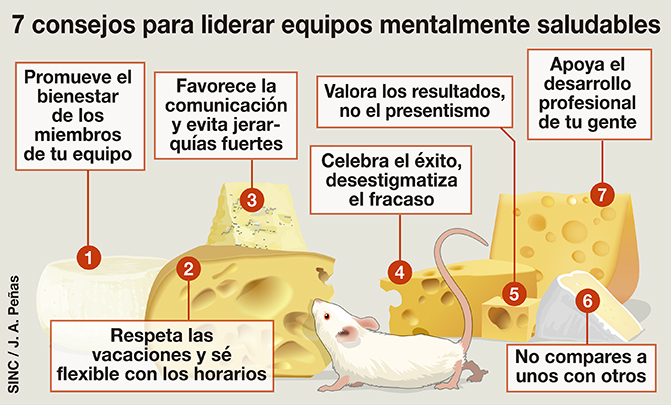
7 consejos para liderar equipos mentalmente saludables

The mirror becomes an object that they cannot live without. They fall in love with their own reflection and believe that they deserve special treatment, becoming aggressive if they don't receive it. For the first time, a Spanish study carried out on 591 adolescents and their parents demonstrates that exposure to violence in the home, a lack of affectionate and positive communication between parents and children, and a permissive upbringing all create narcissistic adolescents who physically or verbally assault their parents.
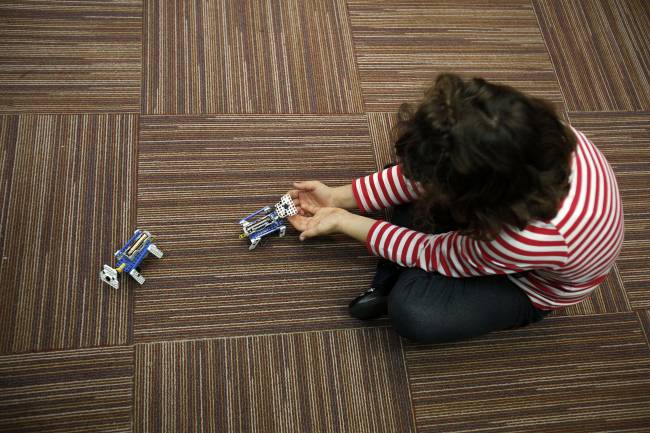
A study carried out in Spain analyses the variables involved in behavioural problems of children in foster care. The study concludes that emotional relationships and educational style are key to reducing problems with children and the strain on foster families.
Lo sentimos, Inténtalo de nuevo más tarde. .