US and Spanish researchers have used a polymeric material to replicate the body of the Agrilus planipennis, a beetle that invades woods in North America. The decoy reproduces the texture and iridescent green colour of the females’ shell on a nanometric scale, and does so with such perfection that the males pounce on them as if they were real. In this way they can be caught and populations of this pest reduced.
Investigadores de EEUU y España han replicado con un material polimérico el cuerpo de Agrilus planipennis, un escarabajo invasor de los bosques de Norteamérica. El señuelo reproduce a escala nanométrica la textura y el verde iridiscente del caparazón de las hembras, con tanta perfección que los machos se lanzan sobre ellas como si fueran de verdad. De esta forma se los puede atrapar y reducir las poblaciones de esta plaga.
Investigadores de EEUU y España han replicado con un material polimérico el cuerpo de Agrilus planipennis, un escarabajo invasor de los bosques de Norteamérica. El señuelo reproduce a escala nanométrica la textura y el verde iridiscente del caparazón de las hembras, con tanta perfección que los machos se lanzan sobre ellas como si fueran de verdad. De esta forma se los puede atrapar y reducir las poblaciones de esta plaga.
Investigadores de EEUU y España han replicado con un material polimérico el cuerpo de Agrilus planipennis, un escarabajo invasor de los bosques de Norteamérica. El señuelo reproduce a escala nanométrica la textura y el verde iridiscente del caparazón de las hembras, con tanta perfección que los machos se lanzan sobre ellas como si fueran de verdad. De esta forma se los puede atrapar y reducir las poblaciones de esta plaga.
Investigadores de EEUU y España han replicado con un material polimérico el cuerpo de Agrilus planipennis, un escarabajo invasor de los bosques de Norteamérica. El señuelo reproduce a escala nanométrica la textura y el verde iridiscente del caparazón de las hembras, con tanta perfección que los machos se lanzan sobre ellas como si fueran de verdad. De esta forma se los puede atrapar y reducir las poblaciones de esta plaga.
The emerald ash borer (Agrilus planipennis) is an Asian beetle which for the last two decades has been threatening the American Ash, the tree that offers its shade in many residential areas of the USA and provides the wood for their prized baseball bats.
Now, researchers from three American universities and the Autonomous University of Madrid (UAM) have come up with an ingenious solution to fight this invader: tricking and trapping males with an artificial female.
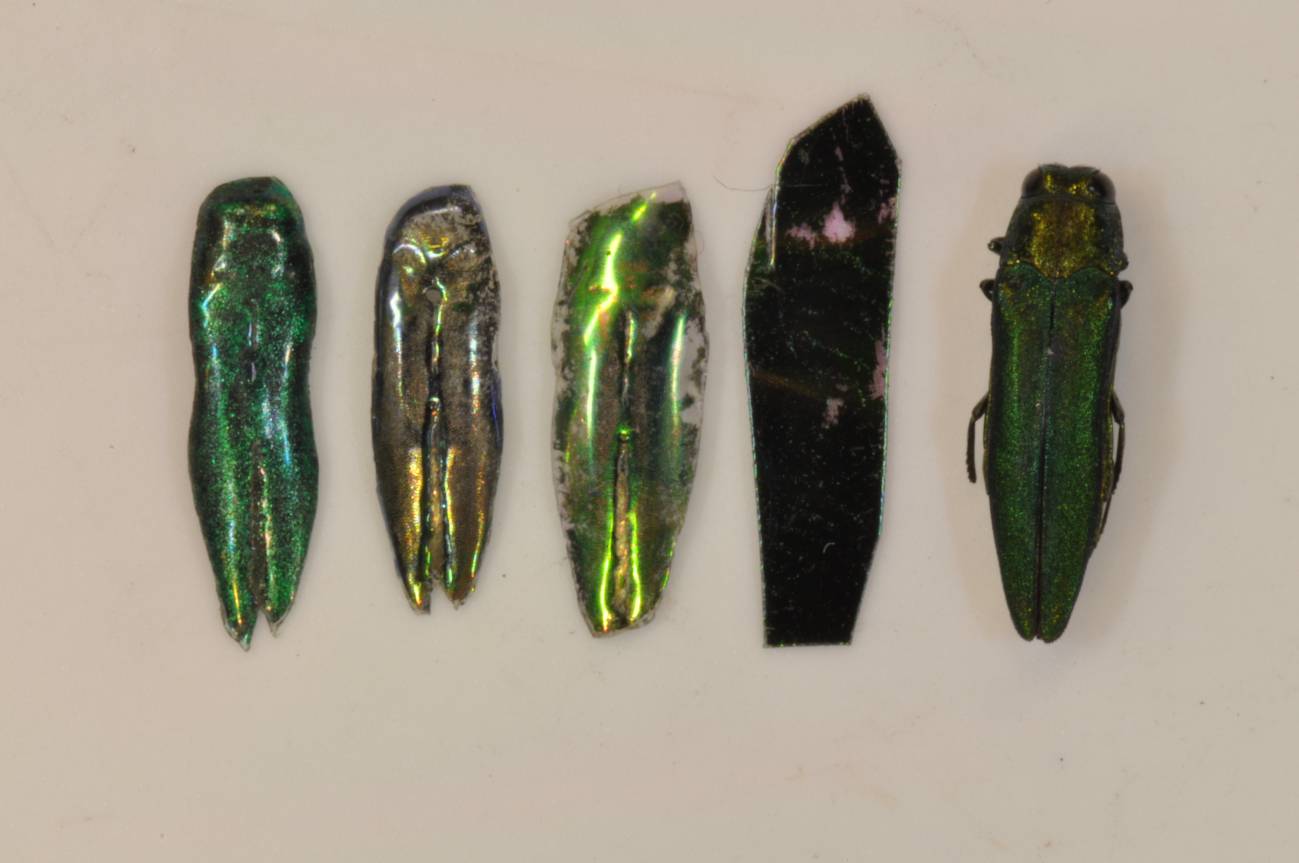
The scientists have produced a mould that imitates the female insect’s upper body on a nanometric scale. Onto this a polymeric material, formed of alternate layers of polyvinyls and acrylics on a substratum of polyethylene terephthalate, is deposited and stamped. The details are published in the ‘Journal of Bionic Engineering’.
“This combination of polymers and alternating layers enables light to be refracted, generating a colour very similar to the iridescent green that is characteristic of the females, as well as their texture,” outlines Raúl J. Martín-Palma, Professor from UAM’s Department of Applied Physics and co-author of the study.
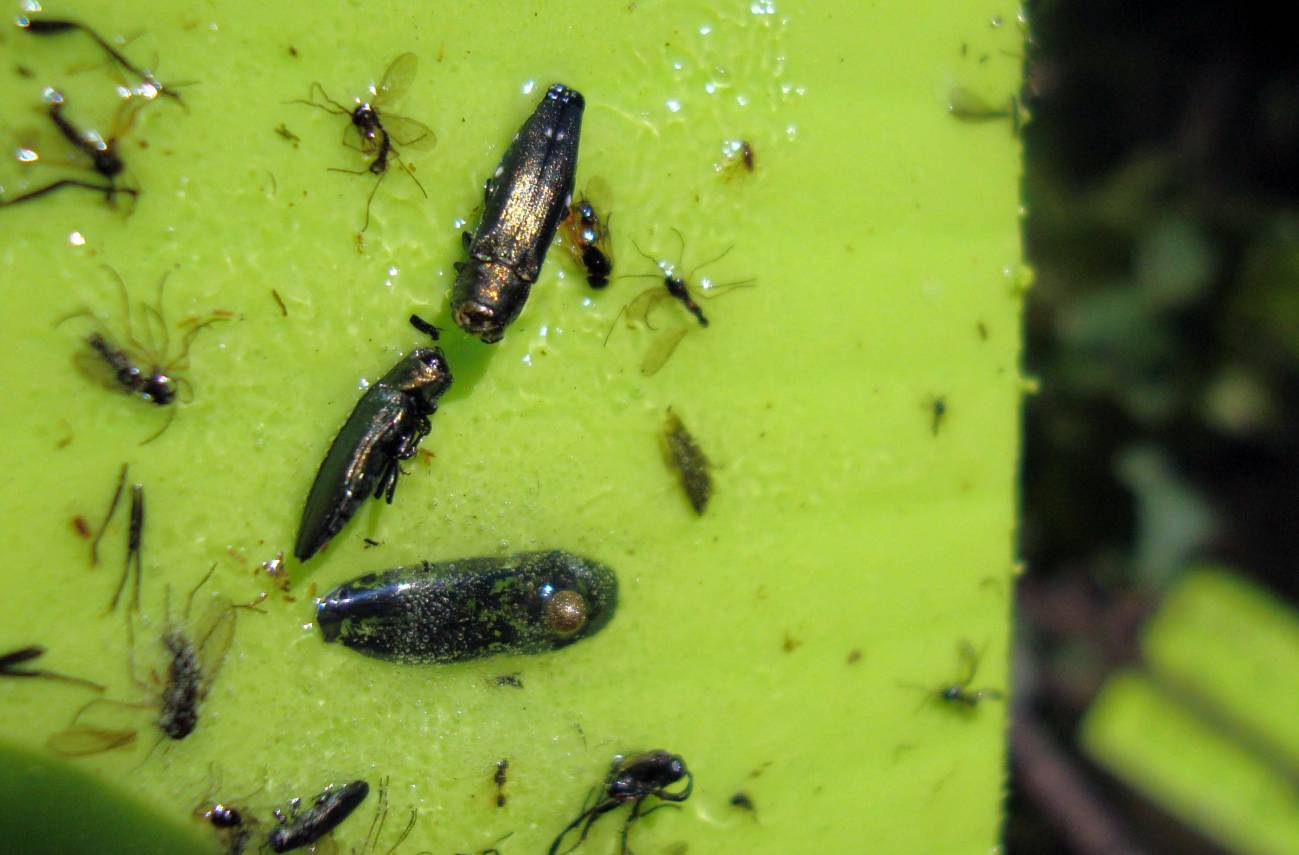
In such a way, decoys can be produced and placed on sticky traps. Male beetles associate them with attractive females and pounce directly onto them, only to be fatally trapped. Thus populations of the invading insect can be reduced.
Until now a similar technique using dead females was employed, but their bodies are excessively fragile and a large number of bodies is required for the traps.
However, the researchers have obtained over 100 replicas from a single mould, therefore it is considered relatively easy to mass-produce polymeric ‘beetles’ and keep them in good, well-maintained conditions.
“The artificial decoys have resulted 40% more effective at trapping male beetles than those consisting of dead bodies,” Martín-Palma affirms.
This is confirmed by the results of an experiment carried out in woods in Hungary. The technique was tested in this European country because in North America the emerald ash borer season had not yet begun when the replicas were ready.
The researchers believe that the fabrication of polymeric females could prove effective in controlling plagues of other species of beetle or other invading insects.
References:
Drew P. Pulsifer, Akhlesh Lakhtakia, Mahesh S. Narkhede, Michael J. Domingue, Beverly G. Post, Jayant Kumar, Raúl J. Martín-Palma, Thomas C. Baker. “Fabrication of Polymeric Visual Decoys for the Male Emerald Ash Borer (Agrilus planipennis)”. Journal of Bionic Engineering 10: 129–138, 2013. Doi: 10.1016/S1672-6529(13)60207-3.
The fluorescence emitted by tiny zinc oxide quantum dots can be used to determine the penetration depth of certain substances used in the restoration of historical buildings. Researchers from Pablo de Olavide University have tested this with samples collected from historical quarries in Cadiz, where the stone was used to build the city hall and cathedral of Seville.

A team of Italian researchers from the European consortium Graphene Flagship has discovered that graphene nano-tools can trigger bone formation in a mouse experiment. They hope the discovery will someday have a clinical application.
Lo sentimos, Inténtalo de nuevo más tarde. .