Fledglings give off signals in order to obtain food from their parents when they come to the nest and, in some species, also when their parents are absent. According to a study by the Spanish National Museum of Natural Sciences, female starlings visit their young more when those sounds produced in their absence increase, while the males do not alter their visitation frequency because of the fledglings’ calls.
In birds, the collection of signals made by fledglings so that they receive food from their parents when they come to the nest is known as ‘begging’.
Through these signals, which can be of various types – acoustic, postural, colouration – the adults obtain information about the welfare and needs of their offspring. Reading these signals, they adjust the distribution of food and the care invested in their chicks.
In addition to this type of signalling, the fledglings of some bird species, such as starlings, owls or some woodpeckers, give off other calls when their parents are away from the nest. As well as being little known, these calls are less intense, more subdued and emitted with a lower, very constant frequency.
Scientists from the Spanish National Museum of Natural Sciences have studied these parent-absent calls to examine their function and published an article in the journal ‘Ethology’.
“Our study shows that females visit their nests more – around 40% more visits per hour – when cries made in their absence increased, whereas no difference was found in the males,” Blanca Jimeno Revilla, from the Behavioural Ecology and Endocrinology group of the Spanish National Museum of Natural Sciences (CSIC) and main author of the study, declared to SINC.
The varying parental responses could be explained taking into account that female starlings have a greater investment in caring for and feeding their fledglings than the males, which could imply a greater response capacity to the offspring’s needs.
Playback with starlings
The scientists designed a playback experiment in a colony of spotless starling (Stumus unicolor) which nest in nest boxes in natural conditions in the Madrid mountains, and in which they have established long-term surveillance.
“To reach these conclusions we compared feeding visits made by the male and female to nests with control conditions (background noise), with those made to nests where parent-absent calls were reproduced,” the researcher pointed out.
However, for the experts, the most significant result is the proof that these cries are somehow perceived by females as an indication of hunger and as an incentive to invest in their offspring.
Why call if there is no one to hear you?
In natural conditions, females could hear these signals while searching for food in the nest’s surroundings, or on approaching the nest to feed their fledglings.
New questions also arise from these results for future lines of study, such as those related with the different parental care strategies followed by males and females, or the way in which the role of communication with the parents of these calling chicks exist or engage with that observed in previous studies for interactions between fledglings.
“Our study contributes a new perspective in the research of these signals and suggests that even those behaviours that can appear to us as more simple could have very complex functions and interactions,” she concluded.
This is a good example of how animal behaviour often defies logic and only by carrying out studies with a broad perspective, can the complex existence of ecosystems and their evolution be understood little by little.
Referencia bibliográfica:
Blanca Jimeno, Jaime Muriel, Lorenzo Pérez Rodríguez y Diego Gil. “Sexual Differences in Parental Investment in Response to Parent-Absent Calls”. Ethology 119 (2013). doi: 10.1111/eth.12201
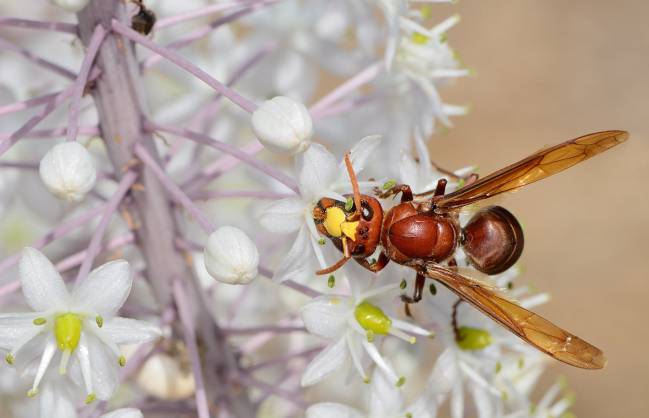
Climate change and globalisation are accelerating the spread of species outside their natural habitat. This is the case of hymenopterans from Asia that are spreading to other continents, whose bites on people are associated with acute kidney diseases. Spanish scientists want to raise awareness of their health consequences.
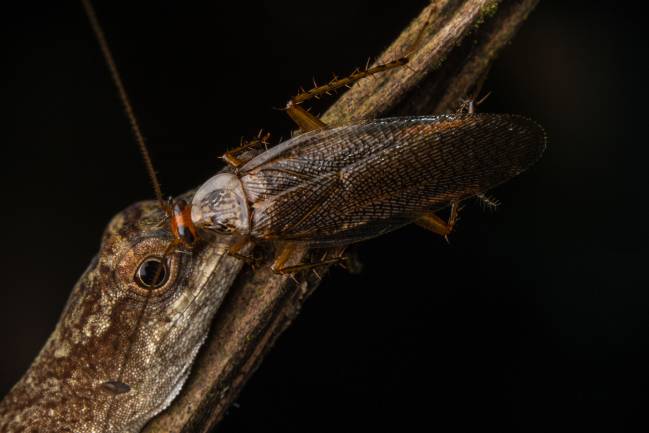
Moths and butterflies are known to complete their diet by drinking the tears of reptiles and birds thanks to the elongated appendage that serves as their mouthpart. But it is not necessary to have such a proboscis to become a “tear drinker”.
Lo sentimos, Inténtalo de nuevo más tarde. .