Football players display different muscle response parameters depending on the position that they hold on the pitch, according to a study conducted by a team of Spanish researchers which has been published in the ‘Journal of electromyography and kinesiology’.
Los jugadores de fútbol presentan diferentes parámetros de respuesta muscular dependiendo de la posición que ocupan en el terreno de juego. Eso es lo que revela un estudio desarrollado por investigadores españoles y publicado en la revista Journal of Electromyography and Kinesiology.
Los jugadores de fútbol presentan diferentes parámetros de respuesta muscular dependiendo de la posición que ocupan en el terreno de juego. Eso es lo que revela un estudio desarrollado por investigadores españoles y publicado en la revista Journal of Electromyography and Kinesiology.
Los jugadores de fútbol presentan diferentes parámetros de respuesta muscular dependiendo de la posición que ocupan en el terreno de juego. Eso es lo que revela un estudio desarrollado por investigadores españoles y publicado en la revista Journal of Electromyography and Kinesiology.
Los jugadores de fútbol presentan diferentes parámetros de respuesta muscular dependiendo de la posición que ocupan en el terreno de juego. Eso es lo que revela un estudio desarrollado por investigadores españoles y publicado en la revista Journal of Electromyography and Kinesiology.
Scientists from the University of Vigo have analysed different muscle response parameters in 78 Spanish first division footballers who have been playing for between four and fifteen years. They found variations depending on the field position of the players.
Published in the ‘Journal of Electromyography and Kinesiology’, the results show that one of the extension muscles of the knee, rectus femoris muscle, belonging to the quadriceps muscle group, has different contraction, contraction maintenance and recovery times according to the specific position of the player on the pitch.
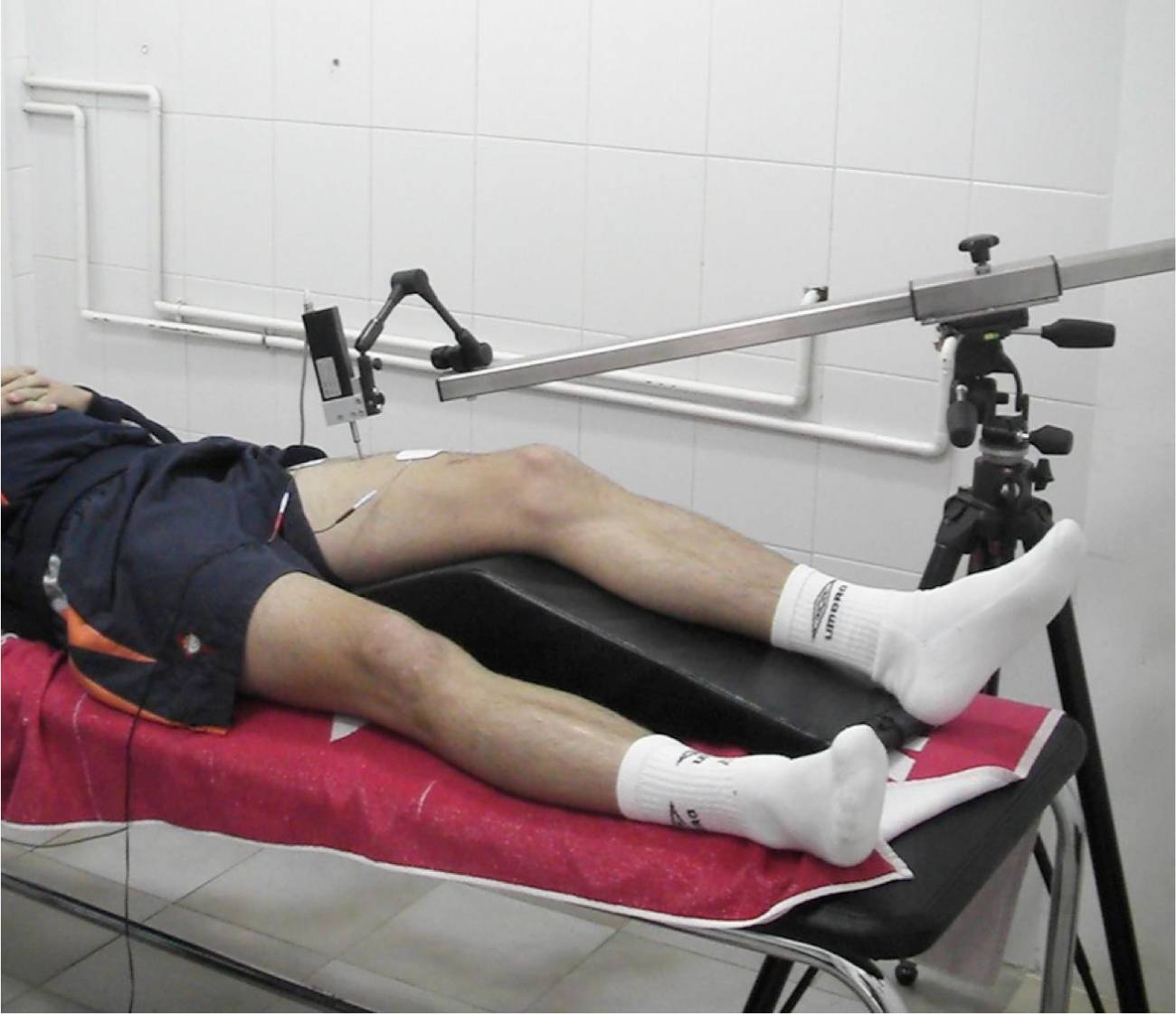
The authors measured the values of these times with a technique developed within the University of Ljubljana (Slovenia) named tensiomyography (TMG), which is used by various first division teams, like Barcelona Football Club.
“It is a non-invasive tool that allows for the assessment of the contracting characteristics of superficial muscles in terms of seconds,” as explained to SINC by Ezequiel Rey, who headed the study.
Goalkeepers need to jump more than wingers
The central defender and the goalkeeper show lower contracting times of the rectus femoris muscle than the side defender. “This is because central defenders and goalkeepers need higher levels of explosive force in the knee extension muscles to jump, stop and head the ball effectively,” outlines Rey.
Furthermore, the midfielders keep this muscle contracted for less time than the rest of the players because they require more resistance.
Preventing injury
The TMG technique allows us “to obtain information on the acute and chronic effects of training on a muscular level, prevent injuries, detect muscle imbalance and muscular asymmetry and assess the state of muscle fatigue after training,” adds the researcher.
Rey points out that the specificity principle “is fundamental in the design of training programmes for complex sports like football,” and he concludes that its study “provides values that can be used when prescribing the training loads in elite football and to reduce the risk of injury in the different specific positions.”
Reference:
Ezequiel Rey, Carlos Lago-Peñas, Joaquín Lago-Ballesteros, “Tensiomyography of selected lower-limb muscles in professional soccer players”. Journal of Electromyography and Kinesiology. 22 (2012) 866–872. Junio de 2012. DOI: 10.1016/j.jelekin.2012.06.003

In addition to being a benchmark in the field of molecular biology, Margarita Salas was a scientist who was known to the public, something almost miraculous in a country like ours, let alone with women.
Spanish and Italian researchers have proven that when honey from strawberry trees, a product typical of Mediterranean areas, is added to colon cancer cells grown in the laboratory, cell proliferation is stopped. The authors hope that these promising results and the anti-tumour potential of this food will be confirmed in in vivo models.
Lo sentimos, Inténtalo de nuevo más tarde. .